Science by Sarah
A portfolio blog showcasing the biology experience of Sarah Holt

About Me
I am a current senior in the biology degree program at Old Dominion University. I graduated from Tidewater Community College in the summer of 2017. Once I completed my Associates of Science degree, I transferred to Old Dominion University in the fall of 2017 to earn a Bachelors of Science.
COVID-19 Virions and Their Impact on the Human Body
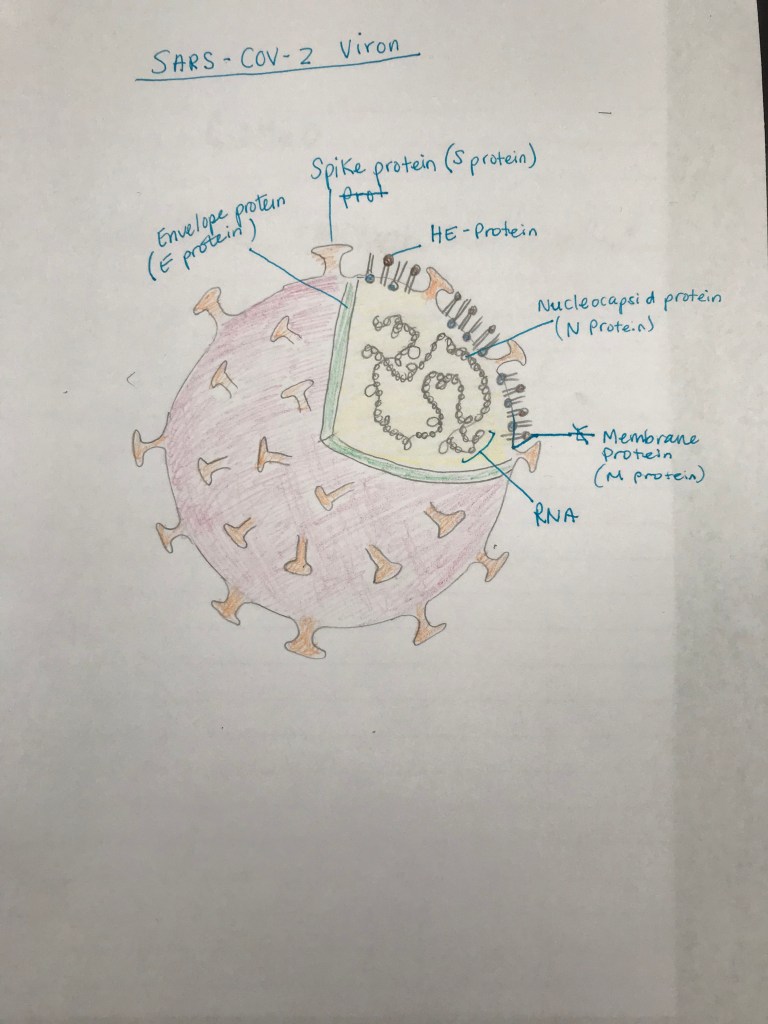
The Coronavirus virions responsible for the current pandemic are named for the outer layer of spikes on their envelope resembling the corona of the sun. The novelty virus SARS-COV-2 is a highly successful virus that is transferred through human to human contact. The virus is enveloped and contains a massive positive-sense single-stranded RNA genome. The alternative genomes consist of negative-sense single stranded RNA, double-stranded RNA, double-stranded DNA, and single-stranded DNA. It has a nearly 30 kb genome. The genome is organized from a 5’ tail to a 3’ tail. It has several proteins in its spikes, envelope, membrane, and nucleocapsid. Some of the SARS-COV-2 proteins are phosphorylated. These proteins are S-spike, HE-hemagglutinin, Replicase, M-membrane, E-envelope, and the N-nucleocapsid. Each of these sections contain a protein that has a specific function aiding in the attachment, replication, protection and overall survival of the virus. (Fehr and Perlman 2015)
These proteins aid in the survival of the virus in numerous ways. For example, the N gene of the virus organizes the viral genome. The M gene is part of the outer structure that helps the newly formed virus particles escape from the host cell. It also is a part of the nuclear coating of the virus. The E gene of the virus helps with assembly and release of the virion. The S gene also aids in host cell entry and forms the outer structure of the virion. Lastly, the HE gene increases the disease symptoms in the host it is occupying. (Fehr and Perlman 2015)
The SARS-COV-2 is a positive-sense RNA virus. This means that the virus uses single stranded RNA as its genetic material. The positive-sense relates to the orientation of the RNA strand. This orientation impacts the replication as it can function as both mRNA and as the genome. If the virus was a negative-sense virus, it would require conversion to a positive-sense RNA. Negative-sense viruses are not infectious unless it is converted to a positive-sense RNA. (Fehr and Perlman 2015)
The virus is able to enter the cell through attaching itself with its outer spike glycoprotein to the angiotensin-converting enzyme 2, or ACE2 for short. ACE2 is responsible for breaking down proteins to help maintain a healthy blood pressure in humans. It regulates blood pressure by assisting the chemical breakdown of angiotensin II into angiotensin (Keidar, et al. 2007). This receptor is located in the brain, kidney, liver, spleen, bone marrow, thymus, lymph nodes, colon, stomach, small intestine, lung, nasopharynx, and nasal mucosa cells (Hamming I., et al. 2004). Because of this, there are many places for the virus to invade. However, in order for the cell to successfully enter the host cell, the spike protein must be primed by an enzyme called a protease This protease is known as TMPRSS2 (Ghasemi and Mousavizadeh 2020). After the initial invasion the virus enters the cytoplasm where it is able to effectively attach to the cellular membrane. Once here, the virus expels its genetic material into the cytoplasm of the cell. The RNA belonging to the virus is then replicated in the cytoplasm membrane (Ghasemi and Mousavizadeh 2020). One notable feature of the coronaviruses is the ability of mRNA to carry out protein synthesis functions. Once synthesised, particles of the new RNA bud into mature forms (Ghasemi and Mousavizadeh 2020). The genome of COVID-19 is massive. It is about 26.4-31.7 kb (Ghasemi and Mousavizadeh 2020).
After the RNA is replicated, it assembles new virions. These virions are expelled through the cell surface through exocytosis (American Nutrition Association 2020).
Symptoms of this virus predominately include a dry cough, fever, tiredness, shortness of breath, chest tightness, body aches, nasal congestion, sore throat, and in some cases, diarrhea (World Health Organization 2020). For the most part, inhibiting the ACE2 enzyme affects the areas where ACE2 is found. Since the ACE2 enzyme is present in all of the areas that can present symptoms, symptom manifestation in these areas is logical. It is debatable whether encouraging the presence of ACE2 would help with confusing the virus or prove to further the amount of attachment locations for the virus (Guite, 2020). Furthermore, the immune response and presence of white blood cells actually promote inflammation in the lungs and secretion of fluids by the cells. It becomes difficult to breathe when the area usually accessible for oxygen intake becomes lessened in surface area (Guite, 2020). This, ultimately, can lead to breathing difficulty or pneumonia.
In short, this extremely complicated disease is proving difficult to contain and treat. It is effective in its transport from one host to another. The virus possesses everything it needs to do well and thrive in its host. Approximately 80% percent of people infected with the virus will show mild symptoms or be asymptomatic entirely (Guite, 2020). When the disease does not express symptoms in some people, it makes the disease even more difficult to track and control. Between 40-70% of the global population will contract the virus, 13.8% of this population will require hospitalization (Guite, 2020). This is a successful virus in the family of other dangerous and widespread virus strains. There is much to learn about the virus, its mechanisms, and the best way to bring about its demise.
Bibliography
Anthony Fehr and Stanley Perlman (2015) ‘Coronaviruses: An Overview of Their Replication and Pathogenesis’ HHS Public Access. doi:10.1007/978-1-4939-2438-7_1.
Guite, H., 2020. What Are The Effects Of COVID-19 On The Lungs?. [online] Medicalnewstoday.com. Available at: <https://www.medicalnewstoday.com/articles/covid-19-what-happens-inside-the-body#Phase-4:-Acute-respiratory-distress-syndrome,the-cytokine-storm,-and-multiple-organ-failure> [Accessed 26 April 2020].
Hamming I., et al. (2004) ‘Tissue distribution of ACE2 protein, the functional receptor for SARS coronavirus. A first step in understanding SARS pathogenesis.’ The Journal of Pathology, Volume 203, issue 2. https://doi.org/10.1002/path.1570.
Leila Mousavizadeh and Sorayya Ghasemi (2020) ‘Genotype and Phenotype of COVID-19: Their roles in pathogenesis’, Journal of Microbiology, Immunology and Infection, https://doi.org/10.1016/j.jmii.2020.03.022.
Personalized Nutrition and the COVID-19 Era (2020) American Nutrition Association. Available at: https://theana.org/COVID-19 [Accessed 26 April 2020].
Q&A on coronaviruses (COVID-19) (2020) World Health Organization. Available at: <https://www.who.int/news-room/q-a-detail/q-a-coronaviruses#:~:text=symptoms> [Accessed 26 April 2020].
Shlomo Keidar, et al. (2007) ‘ACE2 of the heart: from angiotensin I to angiotensin (1-7)’, Cardiovascular Research, 73(3), pp. 463-469. https://doi.org/10.1016/j.cardiores.2006.09.006
SARS-COV-2 Viron
Cell Biology Re-cap
This semester I have had the pleasure of taking cell biology. I expected it to be a rundown of all of the organelles that a cell possess and not much more. However, it has been entirely different from my original expectations. I have learned so much about the inner workings of cells. Things that I could not imagine existing do exist and occur in meticulous detail in the shadows. Many things I encountered surprised me this semester. The most incredible opportunity was to have an in-depth look at all of these mechanisms for survival and reproduction of cells in living organisms. For me, cell biology is much more involved and more specific than anything I will teach in a middle school classroom, but it is nice to have the understanding and knowledge so that I may share it with future students. I hope that the knowledge I have acquired this semester will benefit either me or my future students as I start my career as an educator.
 Sarah's Science Blog